The Re Knowing

Identity is who you are, the way you think about yourself, the way you are viewed by the world and the characteristics that define you
As a society we are often encouraged to be beige and blend in.
This project was aimed to allow children to develop their own theories and understandings on how identity is impacted by connections.
Bringing focus and understanding that all things, living and non-living, express and have the right to an identity. The children are given time to discover a deeper meaning to their identity, both individual and shared. Who are they in a collaborative environment? Unpacking and sharing their dispositions, discovering what parts of their identity they choose to share in a community setting.
Through this project we have delved deeper into our “me- ness” to discover who we are and the impact that has on others.
As an educator I had wonderings about the children’s perceptions around their self-identity and what this would look like and mean to the children.
I intentionally selected the group of children based on their strengths, dispositions, and their ability to scaffold from one another.
One of the most significant principles of Reggio Emilia that we draw from is the hundred languages of children. The Hundred Languages tells us that children learn and tell their story through many different forms of expression.
Children used drawing, plasticine, and storytelling to elaborate more deeply on what they could communicate in discussion.

“Children are capable of influencing others’ perceptions of their self-identity by choosing the parts of themselves that they share.”
Hypothesis
Enquiry
We then began discussions about identity…. What is it, who has one?

Tully
“it’s my name”
Digby
“Making myself, yourself who you are.”
Lachlan
” playing with wheelbarrows and things you like”

Walker
“it’s a type of bin, maybe a blue bin.”
Harlee
“my home and my family.”

this was a popular topic with the children as I had began the identity discussion by introducing our blue bin, with the idea that it needed an identity too. how would people know it belongs to child care?
We looked at other painted bins from around our community and had discussions about what story the picture told about their identities? This made us reflect on our own identity. what did we want to share about us, here at childcare? What was it and how would we share our identity?
Walker was referring to the decorated blue recycling bins that had began showing up around town


Tully and Digby researching other bin identities in our community.
Digby
“Maybe the people that live here like emus and stars?”
It was as if the bin demanded a closer look, a new perspective.
The children were invited to create an identity through storytelling, who was the bin? The children participated in this rich and meaningful enquiry-based experience, collaboratively creating an imaginary identity for our bin.
The children used prior knowledge of literacy and play to make successful connections from one context to the next.
My enquiry shifted slightly through the project as we began to unpack this idea together “How do we share the unseen identity of ourselves as part of a community”?
We began looking deeper and unpacking identity not just as individuals so much but also as a group representing our community, our childcare.
The children were not asked to ‘design’ childcare, but to participate in the search for the meaning and the identity that we give our centre
an identity that we could share with others.
Mapping out identity! with Drawings, scaffolding, and conversations lead us to the conversation of what identity looks like to the children,

Walker
“It’s childcare”
Tully
“It’s a building”.
Walker
“You have to drive here.”
Tully
“It’s in the Mount, Mount Gambier.”
Nik
“Our Childcare is on Derrington Street.”
Harlee
“I live in Mount Gambier; you have to go past the doctors and the shops to get to my house.”
Tully
“I live at Port Mac”
Lachlan
“I live too far away, not close to childcare.”
Walker drew childcare, Tully added Children, so everyone knew it was childcare.

Walker
“I live close to childcare did you know? You just go past rock-climbing and the bad man’s house and you’re at my house.”

Tully
“There is lots of people that come to childcare, it’s like a big family”
The children scaffolded from one another broadening their understanding of the world which they live, developing a larger sense of belonging. Creating connections between their individual identities and a collaborative, community identity.
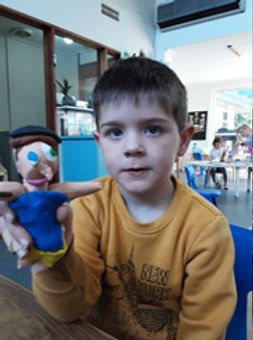
Through the language of clay some identities were created,
Lachlan
“I’m going to make me"
" I’m going to roll it and poke a hole for my eyes.”
“I have a smile and big arms.”
Walker
” it’s me I like all of my clay self.”
"Look Nik I’m turning into a real clay monster!”
Tully
“I’m making a snowman! She’s name is Tully she likes the same things as me, babies and stuff.”
"she will live at the same place as me.”
"Her identity is she has an arm and a name!”


Harlee
“It’s going to be a penguin, penguins have arms he is called giant penguin and he has four arms.”
“He needs eyes"
" I want to choose fun eyes and a chomping mouth to eat fish.”
The conversations in our project time became richer; there was lots of discussion and provocation from Nik as we discussed who are we in a small, shared identity such as our family?
Educators used familiar contexts relating to the children to promote the conversations.
There was a common thread as the children all drew pictures of their family and shared their role or identity within their family to connect to and understand the concept of their own identity.
Family conversations led to us exploring the concept of a community identity further.
Along with this we also looked at other shared identities the children could relate to such as paw patrol.
Who is paw patrol and how many different identities make up the shared identity? Disney the castle logo, AFL, and community places such as the Tree House Play cafe.
When talking about the Tree House we had conversations about the type of people/identities that might go there.

This experience allowed the educator to use Marte Meo techniques, supporting the children’s language and ideas to feel recognized and respected for who they are.
The children were encouraged to build on their creative dispositions and share a strong sense of belonging to the “project group”.
It was evident to educators through this experience the children were developing a strong sense of identity as they openly expressed their feelings and ideas in their interactions with one another.
There was a new sense of connection in the group as the conversations began to demonstrate how their community influences their identity.
Digby connected his self-identity as a part of a larger identity - his family. Digby says, “He is the little brother, Alex his big brother has jobs, and he hates jobs,”


Walker.
“I go there with my family, so everyone is allowed to go there.”
“Well everyone who lives in Mount Gambier, my house is near the Tree house.”
Jordan
“It needs to be a map so were all connected”
Tully
“Children, that’s what makes Child Care, we will hold hands that’s what you do when your best friends.”
Digby
“The map needs a baby room and us, my Mum works in the baby room.”
Tully
“The footprints are part of childcare”
Jordan
“We need to connect the pictures together; if we do the footprints, everyone will know it’s the front.”
The children shared knowledge promoting a strong sense of who they are and their connectedness to their community and surrounds.
After lots of democratic discussion and drafts it was decided there would be two presentations to represent our shared identities, a map, and a model display of a community identity.
This is because when educators figure out what the individual child’s ideas and intentions were, it was evident that only one product would not suffice nor benefit the group of children with the diverse skill set between them.
The map
Digby, Tully, and Jordan. It was evident in their drawings and conversations that they felt location was key to an identity. These children would continue to draw maps of childcare, where they live and their surroundings.


above are the conversations that show the growth in the children’s learning as they develop a sense of connectedness and belonging to groups and communities building on their own social experiences to explore other ways of being.
Children’s identities connected with their community identity.
The children demonstrated persistence and concentration. They were so invested that they created many drafts using different mediums to get the map how they wanted it,
it had to be exactly right.

The Crowd
For Harlee, Lachlan and Walker it was more evident they were focused on the people who make up a community that demonstrates shared identity. Drawing themselves, their siblings, parents, and grandparents that inhabit our shared space, even if only for a short time.
Once they had created their individual people to form a crowd, Nik posed the question, what was the difference between the “community” identity and their “self” identity? The theme was that common community was connected and shared, while self was just them.

Harlee
"Community is Xavier, me and Maxy, self is me"
Lachlan
“you say hello to people, people are your friends.”
"People grow trees and bushes they have to work together.”
“Self-identity, I’m Lachlan”
Tully
"A name who you are as lots of people who come to the same place, like they share Child Cares name.”
“Self-identity, I’m just Tully from Port Mac.”
Jordan
“shared identity means part of the village room;
it means I belong there.”
“Self-identity means my name.”
Digby
“community is caring and loving for everyone.”
“Self-identity, I’m Froggy I can write Froggy and Digby, Froggy likes to play computer games”.
Walker
“friends and me I’m people’s friends.”
“Self means my name just me.”
Nik also posed the question of her own identity to the children?
Jordy
“your identity is a teacher and a mum you have Chelsea’.
Tully
“a community identity I think because you are all our friends”.
These ideas and conversations with the children really Embedded the sense of identity, connectedness, belonging and
comfort in their shared environments.